

Free Check Engine Light Scan vs Diagnostic Inspection: What's the Difference?
Your vehicle's dashboard warning lights are designed to alert you when something isn't working correctly. Whether it's a Check Engine Light, ABS Light, Traction Control Light, or another warning indicator, it's natural to want answers quickly.
At Auto Select, one of the most common questions we hear is:
"Why does it cost money to diagnose my warning light when the code scan is free?"
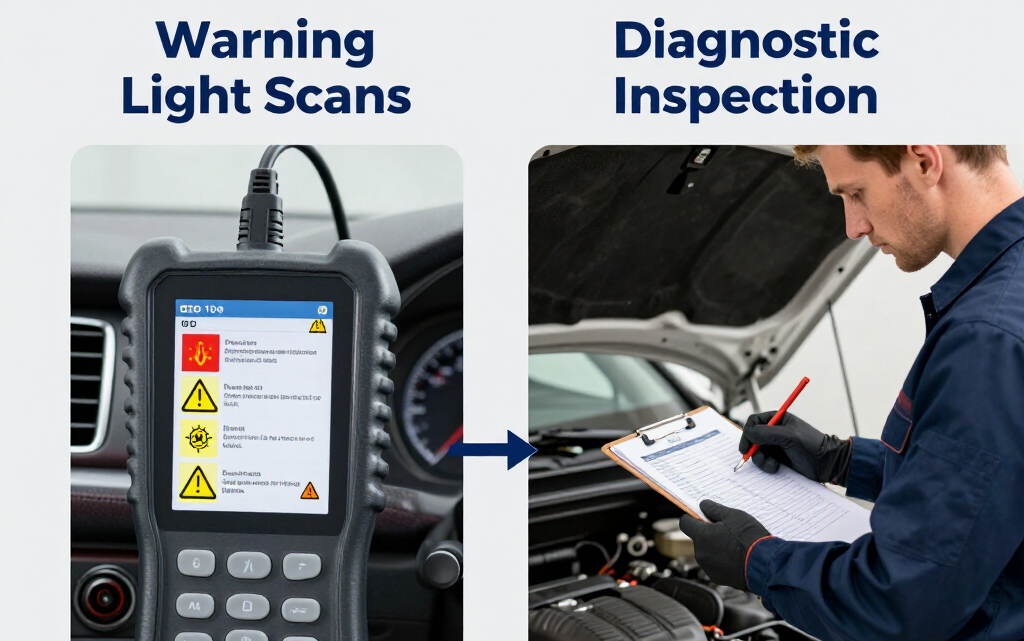
The answer is simple: A code scan tells us where to start looking. A diagnostic inspection determines what's actually causing the problem.
What Is a Free Check Engine Code Scan?
A free code scan involves connecting a scan tool to your vehicle's computer and retrieving any stored trouble codes.
For example, your vehicle may display:
- P0302 – Cylinder #2 Misfire
- P0420 – Catalyst Efficiency Below Threshold
- P0171 – System Too Lean
- P0456 – Evaporative Emissions Leak Detected
This information is helpful because it points technicians toward the affected system. However, the code itself rarely tells us which part has failed.
Think of it like this:
If you visit a doctor because your stomach hurts, the doctor doesn't immediately remove your appendix. They ask questions, perform tests, and determine the actual cause of the pain.
A check engine code works the same way. It identifies a symptom, not necessarily the failed component.
Why Can't I Just Replace the Part Listed in the Code?
Many people assume that a code automatically means a specific part needs replacement.
Unfortunately, that's often not the case.
For example:
Code P0420 – Catalyst Efficiency Below Threshold
Many drivers believe they need a new catalytic converter.
However, the real cause could be:
- An exhaust leak
- A failing oxygen sensor
- An engine misfire damaging the converter
- Fuel system issues causing improper combustion
- A catalytic converter that has actually failed
Replacing the converter without testing could cost hundreds or even thousands of dollars unnecessarily.
Code P0300 – Random Misfire
This code doesn't tell us what caused the misfire.
Possible causes include:
- Worn spark plugs
- Faulty ignition coils
- Vacuum leaks
- Low fuel pressure
- Dirty fuel injectors
- Internal engine problems
The only way to know for certain is through proper testing and diagnosis.
What Happens During a Diagnostic Inspection?
A diagnostic inspection is much more involved than simply reading codes.
At Auto Select, our technicians may perform:
Computer System Analysis
We review:
- Stored and pending trouble codes
- Freeze-frame data
- Live sensor readings
- Manufacturer-specific information
- Technical service bulletins
Electrical Testing
Many warning lights are caused by electrical issues, including:
- Wiring damage
- Corroded connectors
- Failed sensors
- Voltage drops
- Ground faults
Our technicians use specialized equipment to test circuits and verify component operation.
Mechanical Inspection
Some warning lights originate from mechanical failures, such as:
- Vacuum leaks
- Exhaust leaks
- Engine timing issues
- Fuel delivery problems
- Internal engine wear
A hands-on inspection is often necessary to pinpoint the root cause.
Road Testing
Some problems only occur:
- At highway speeds
- Under heavy acceleration
- During cold starts
- When the engine reaches operating temperature
A road test allows our technicians to duplicate the concern and gather additional data.
Why Does a Diagnostic Inspection Cost Money?
Diagnosing a warning light requires:
- Advanced scan tools
- Specialized testing equipment
- Access to manufacturer information
- Years of technician training and experience
- Time spent testing and verifying repairs
In many cases, the technician spends more time diagnosing the problem than replacing the actual part.
The goal isn't simply to clear the warning light—it's to accurately identify the cause and recommend the correct repair the first time.
Why Accurate Diagnosis Saves You Money
It may seem counterintuitive, but paying for a professional diagnostic inspection often saves money in the long run.
Without proper diagnosis, drivers sometimes replace:
- Oxygen sensors that weren't faulty
- Spark plugs that weren't causing the issue
- Batteries that test good
- Alternators that are functioning properly
- Catalytic converters that aren't the real problem
Guessing at repairs can quickly become expensive.
A professional diagnosis helps ensure:
- The correct repair is made
- Unnecessary parts aren't replaced
- Problems are fixed faster
- Warning lights don't return shortly after repairs
What About Other Warning Lights?
The same principle applies to:
- ABS Warning Lights
- Traction Control Lights
- Airbag Lights
- TPMS (Tire Pressure Monitoring System) Lights
- Hybrid System Warnings
- Battery or Charging System Lights
A code scan may reveal which system is affected, but additional testing is usually required to determine the exact cause.
Trust the Experts at Auto Select
At Auto Select, we're happy to provide a free code scan when possible to help point you in the right direction.
When additional testing is needed, our trained technicians use advanced diagnostic equipment and proven testing procedures to accurately identify the cause of your warning light.
Our goal is simple:
Fix your vehicle correctly the first time, save you money on unnecessary repairs, and get you back on the road with confidence.
If your Check Engine Light or another dashboard warning light has come on, visit your nearest Auto Select location. We'll help you understand what's happening with your vehicle and recommend the best path forward.